Friday, July 31, 2009

liver cancer

Signs and Symptoms
Liver cancer is a disease involving uncontrolled growth of cells within the liver.
Cancer in the liver may be primary or secondary, also called metastatic. Primary cancer arises within the liver and in its early stages exists only within the liver. People who have hepatitis B or C, viral infections of the liver, or cirrhosis of the liver are more likely than other people to develop primary liver cancer. At an early stage primary liver cancer may cause no symptoms at all. More advanced disease may cause loss of appetite, weight loss, fever, fatigue and weakness.
Secondary liver cancer is term for cancer that originates in another organ, such as the colon, stomach, pancreas and breast and then spreads to the liver. Because secondary cancer is present in at least two organs, the treatment possibilities are more limited than for primary liver cancer. As the cancer grows, pain may develop in the upper abdomen on the right side and may extend into the back and shoulder. With advanced disease, the signs of liver failure appear, which include abdominal swelling and a feeling of fullness or bloating and jaundice, a condition in which the skin and the whites of the eyes become yellow and the urine becomes dark.

Diagnosis

In making a diagnosis of liver cancer, your doctor will evaluate your medical history and perform a careful physical examination. Certain tests also will be recommended. For people at increased risk of developing primary liver cancer, such as those with chronic viral hepatitis or cirrhosis, the current recommendation is to have an alpha-fetoprotein blood test and an ultrasound examination of the liver, at least annually. While not perfect, these tests increase the chances of detecting liver cancer at an early stage.
Certain blood tests are used to see how well the liver is functioning. X-rays of the chest and abdomen, angiograms or X-rays of blood vessels; CT scans , or X-rays put together by computer; and MRIs, or magnetic resonance images, created by using a magnetic field, may be part of the diagnostic process. If there is uncertainty about the diagnosis, the presence of liver cancer may be confirmed with a biopsy. Tissue from the liver is removed through a needle or during an operationand checked under a microscope for the presence of cancer cells. Your doctor also may look at the liver with an instrument called a laparoscope, which is a small tube-shaped instrument with a light on one end. For this procedure, a small cut is made in the abdomen so that the laparoscope can be inserted. Your doctor may take a small piece of tissue during the laparoscopy. A pathologist then examines the tissue under the microscope to see if cancer cells are present. Once primary liver cancer is found, more tests will be performed to determine if cancer cells have spread to other parts of the body. The following stages are used for adult primary liver cancer:
Localized respectable: Cancer is found in one place in the liver and can be totally removed in an operation.
Localized unrespectable: Cancer is found only in one part of the liver, but the cancer cannot be totally removed.
Advanced: Cancer has spread through much of the liver or to other parts of the body.
Recurrent: Cancer has come back or recurred after it was treated. It may come back in the liver or in another part of the body.

Treatment

SurgerySurgery is the most common treatment for cancer of the liver.
Radiation therapyRadiation therapy is the use of X-rays or other high-energy rays to kill cancer cells and shrink tumors. Radiation comes from a machine outside the body, or external radiation therapy. Radiation can be used alone or in addition to surgery and chemotherapy.
ChemotherapyChemotherapy is the use of drugs to kill cancer cells. Chemotherapy for liver cancer is usually put into the body by inserting a needle into a vein or artery. This type of chemotherapy is called a systemic treatment because the drug enters the bloodstream, travels through the body, and can kill cancer cells outside the liver. In another type of chemotherapy called regional chemotherapy, a small pump containing drugs is placed in the body. The pump puts drugs directly into the blood vessels, called arteries, that go to the tumor.

Wednesday, July 15, 2009

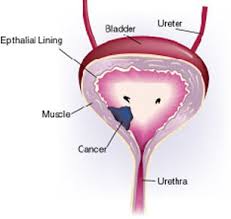
Bladder Cancer

What is bladder cancer?

Cancer is the growth of abnormal cells in the body. These extra cells grow together and form masses, called tumors. In bladder cancer, these growths happen in the bladder.
The bladder is the part of your urinary tract that stores your urine until you are ready to let it out. See a picture of the female urinary system or male urinary system.
Bladder cancer can usually be cured if it is found and treated early. And most bladder cancer is found early.

What causes bladder cancer?

We don't know what causes bladder cancer. But we do know that smokers are much more likely to get it than nonsmokers. In fact, experts believe that smoking causes about half of bladder cancer in men and more than one-fourth of bladder cancer in women.

What are the symptoms?

Blood in the urine is the main symptom. Other symptoms may include having to urinate often or feeling pain when you urinate.
These symptoms can be caused by other problems, including a urinary tract infection. Always call your doctor if you see blood in your urine.

How is bladder cancer diagnosed?

To diagnose bladder cancer, your doctor will:

Ask about your medical history and do a physical exam, including a vaginal or rectal exam.

Test your urine to look for blood or abnormal cells.

Do a cystoscopy, a test that lets your doctor look into your bladder with a thin, lighted viewing tool. Small tissue samples (biopsies) are taken and looked at under a microscope to find out if there are cancer cells.

How is it treated?

Treatment choices for bladder cancer include surgery to remove the cancer, anti-cancer drugs (chemotherapy), medicines that help your immune system (biological therapy), and radiation.
The treatment depends a lot on how much the cancer has grown. Most bladder cancers are treated without having to remove the bladder.
Sometimes doctors do have to remove the bladder. For some people, this means having urine flow into a bag outside of the body. But in many cases, doctors can make a new bladder—using other body tissue—that works very much like the old one.
Bladder cancer often comes back. The new tumors can often be treated easily if they are caught early. So it’s very important to have regular checkups after your treatment is done.
It’s common to feel scared, sad, or angry after finding out that you have bladder cancer. Talking to others who have had the disease may help you feel better. Ask your doctor about support groups in your area. You can also find people online who will share their experiences with you.

What increases your chances of getting bladder cancer?

Anything that increases your chances of getting a disease is called a risk factor. The main risk factor for bladder cancer is smoking. Cigarette smokers are much more likely than other people to get bladder cancer.

Other risk factors include:

Being older than 40.

Being male. Men are 4 times more likely than women to get bladder cancer.

Being exposed to cancer-causing chemicals, such as those used in the wood, rubber, and textile industries.

Wednesday, July 1, 2009

Ovarian Cancer

What is ovarian cancer?

Ovarian cancer happens when cells that are not normal grow in one or both of your ovaries. This topic is about epithelial ovarian cancer, the most common type.
This cancer is often cured when it is caught early. But most of the time, the cancer has already spread by the time it is found.
It is frightening to hear that you or someone you love may have ovarian cancer. It may help to talk with your doctor or join a support group to deal with your feelings.

What causes ovarian cancer?

We do not know what causes it. Some women who have it also have a family history of cancer. But most do not.
Some women are more likely than others to get this rare cancer. Women who are past menopause or who have never been pregnant are more likely to get ovarian cancer.

What are the symptoms?
Ovarian cancer does not usually cause symptoms at first. But most women do have some symptoms in the 6 to 12 months before ovarian cancer is found. The most common symptoms are gas and pain or swelling in the belly. Other symptoms are diarrhea or constipation, or an upset stomach.
But these symptoms are so general that they are more likely to be blamed on a number of other causes. Most of the time, the cancer has already spread by the time it is found.

How is ovarian cancer diagnosed?

Sometimes the doctor may feel a lump in or on an ovary during a routine pelvic exam. Often a lump may be seen during an ultrasound. Most lumps are not cancer.
The only way to know for sure that a woman has ovarian cancer is with biopsies taken during surgery. The doctor makes an incision in the belly so that he or she can look inside. The doctor will remove bits of any tumors that are found and send them to a lab to confirm that they contain cancer.
There is a blood test called CA-125 (cancer antigen 125) that is sometimes done to look for cancer in women at high risk. So far, there is not enough proof to show that this test works to find ovarian cancer early in most women. Too much CA-125 in the blood can be caused by many things, like the menstrual cycle, endometriosis, and uterine fibroids, as well as many types of cancer.

How is it treated?

Surgery is the main treatment. The doctor will remove any tumors that he or she can see. This usually means taking out one or both ovaries. It may also mean taking out the fallopian tubes and uterus. After surgery, most women have several months of chemotherapy, which means taking drugs that kill cancer cells.
This cancer often comes back after treatment. So you will need regular checkups for the rest of your life. If your cancer does come back, treatment may help you feel better and live longer.
Ovarian cancer is very serious, but many women do survive it. It depends on your age and overall health, how far the cancer has spread, and how much cancer is left behind during surgery.
It may help to talk to other women who are going through the same thing. People who take part in support groups usually feel better, sleep better, and feel more like eating. Your doctor or your local branch of the American Cancer Society can help you find a support group. You can also look on the Internet to find support sites where women with this cancer can talk to each other.

What are your chances of getting ovarian cancer?

This cancer most often affects women who are past menopause. Women are more likely to get ovarian cancer if others in their family have had it. They are more likely to get it if they have had breast cancer.

You may also be more likely to get this cancer if:

You never had a baby.
You started your menstrual cycles before age 12 and went through menopause after age 50.

you are unable to become pregnant.

You have used hormone replacement therapy for menopause symptoms.

Lung Cancer

What is lung cancer?

Lung cancer starts when abnormal cells grow out of control in the lung. They can invade nearby tissues and form tumors. Lung cancer can start anywhere in the lungs and affect any part of the respiratory system.
The cancer cells can spread, or metastasize, to the lymph nodes and other parts of the body.

What causes lung cancer?

Most lung cancer is caused by smoking. Secondhand smoke also can cause lung cancer. Lung cancer is the leading cause of cancer deaths.
Being exposed to arsenic, asbestos, radioactive dust, or radon can increase your chances of getting lung cancer. People who are exposed to radiation at work or elsewhere have a higher chance of getting lung cancer.

What are the symptoms?

Early lung cancer doesn't usually cause any symptoms. This is why it's not usually found early.
In its advanced stage, cancer may affect how your lungs work. The first signs of lung cancer may include:

Coughing.

Wheezing.

Feeling short of breath.

Having blood in any mucus that you cough up. If you have these symptoms and are worried about lung cancer, call your doctor.
Lung cancer may spread to the chest and then to other parts of the body. For example, if it spreads to the spine or bones, it may cause pain in the back or other bones or weakness in the arms or legs. If it spreads to the brain, it may cause seizures, headaches, or vision changes.

How is lung cancer diagnosed?

Your doctor will check your symptoms and ask questions about whether you smoke or have been exposed to another person's smoke or to any cancer-causing substances. He or she will also ask about your medical history, including any history of cancer in your family. This information will help your doctor decide how likely it is that you have lung cancer and whether you need tests to be sure.
Lung cancer is usually first found on a chest X-ray or a CT scan. More tests are done to find out what kind of cancer cells you have and whether they have spread beyond your lung. These tests help your doctor and you find out what stage the cancer is in. The stage is a rating to measure how big the cancer is and how far it has spread.

How is it treated?

Treatment for lung cancer includes surgery, anti-cancer medicines (chemotherapy), radiation, or a mix of all three. It depends on what type of cancer you have and how much it has spread.
Few lung cancers are found in the early stages when treatment is most effective.
It can be very scary to learn that you may have lung cancer. Talking with your doctor or joining a support group may help you deal with your feelings. Having support from family and friends can help a lot. And staying as active as possible will also help.
Less than half of people who get lung cancer live 1 more year after the cancer is found. And only about 16 out of 100 people with lung cancer live for 5 or more years. 1 It’s important to remember that everyone’s case is different and that these numbers may not show what will happen in your case.

Can you prevent lung cancer?

Lung cancer is one of the easiest cancers to prevent because most lung cancer is caused by smoking. So it is important to stop smoking—or to stop being around someone else’s smoke.
Even if you have smoked a long time, quitting can lower your chances of getting cancer. If you already have lung cancer, quitting makes your treatment work better and can help you live longer.